

This project involved the redesign of the Colorado Plateau Foundation's case statement alongside the development of a custom illustrated narrative map and supporting outreach materials created to strengthen the Foundation's fundraising, educational, and public engagement efforts. Developed through close collaboration with the Foundation's Executive Director, the project sought to communicate the cultural, ecological, and geographic significance of the Colorado Plateau through an integrated visual communication system grounded in clarity, visual storytelling, and respect for Indigenous perspectives.
The centerpiece of the project was the creation of a narrative-driven illustrated map that moved beyond conventional cartographic representation. Rather than depicting the Colorado Plateau solely as a geographic landmass, the illustration was designed to communicate the region as a living cultural landscape—bringing together Tribal Nations, waterways, public lands, ecological systems, and significant landmarks within a cohesive visual framework. Particular attention was given to balancing geographic accuracy with editorial readability while ensuring that multiple layers of information could be understood intuitively by diverse audiences.
Working closely with the Foundation's Executive Director throughout the design process, the map evolved through multiple rounds of refinement to accurately represent complex regional relationships while remaining visually accessible. An accompanying inset map was developed to provide additional context for geographically dense and culturally significant areas that required greater spatial resolution than could be accommodated within the primary composition. This solution preserved the clarity of the overall illustration while allowing nuanced geographic and cultural information to be communicated with greater precision.
In addition to the narrative map, the project included the redesign of the Foundation's case statement as a publication-quality document supporting organizational storytelling and donor engagement. Editorial hierarchy, typography, imagery, and layout systems were carefully developed to complement the map, creating a cohesive publication that communicates both mission and impact. A double-sided informational flyer was also designed to extend the communication system into a concise outreach piece suitable for presentations, events, conferences, and public distribution.
Created through an iterative and highly collaborative design process, the final suite of materials demonstrates the integration of publication design, information design, cartographic illustration, and visual storytelling. Together, the deliverables provide the Colorado Plateau Foundation with a unified communications system that presents the Colorado Plateau not simply as a geographic region, but as a culturally significant homeland shaped by Indigenous stewardship, ecological diversity, and interconnected landscapes.
Tools: Adobe Illustrator, Adobe InDesign, Adobe Photoshop
Deliverables: Case statement, illustrated narrative map, inset map, double-sided informational flyer, print-ready production files
Focus: Publication design, editorial design, information design, cartographic illustration, visual storytelling, nonprofit communications, Indigenous-centered communication
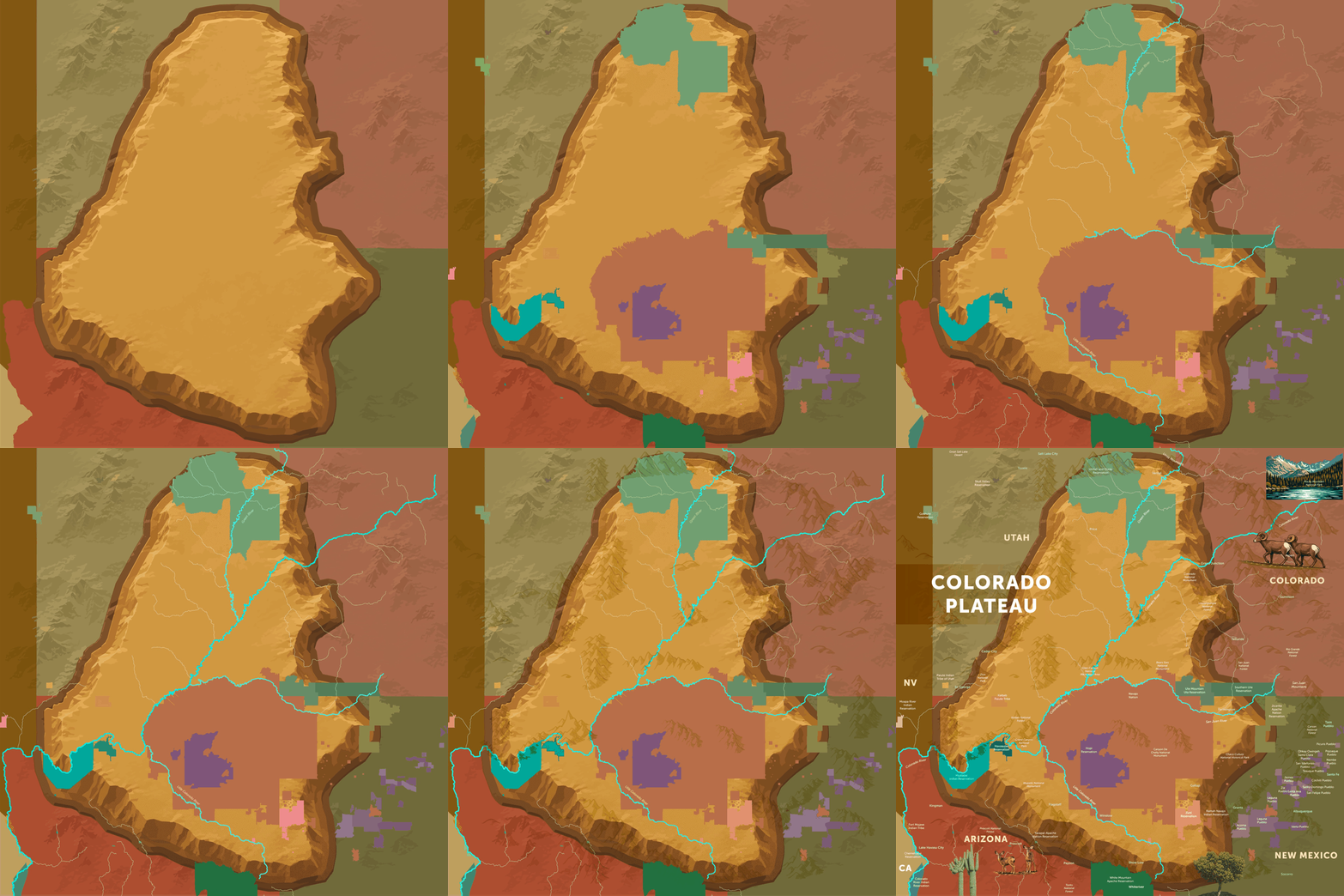
Narrative Map
The centerpiece of the project, this illustrated narrative map reimagines the Colorado Plateau as a living cultural landscape rather than a conventional geographic diagram. Developed through close collaboration with the Colorado Plateau Foundation, the composition integrates Tribal Nations, hydrology, mountain systems, protected landscapes, and regional landmarks into a cohesive visual narrative that emphasizes relationships between land, culture, ecology, and stewardship.
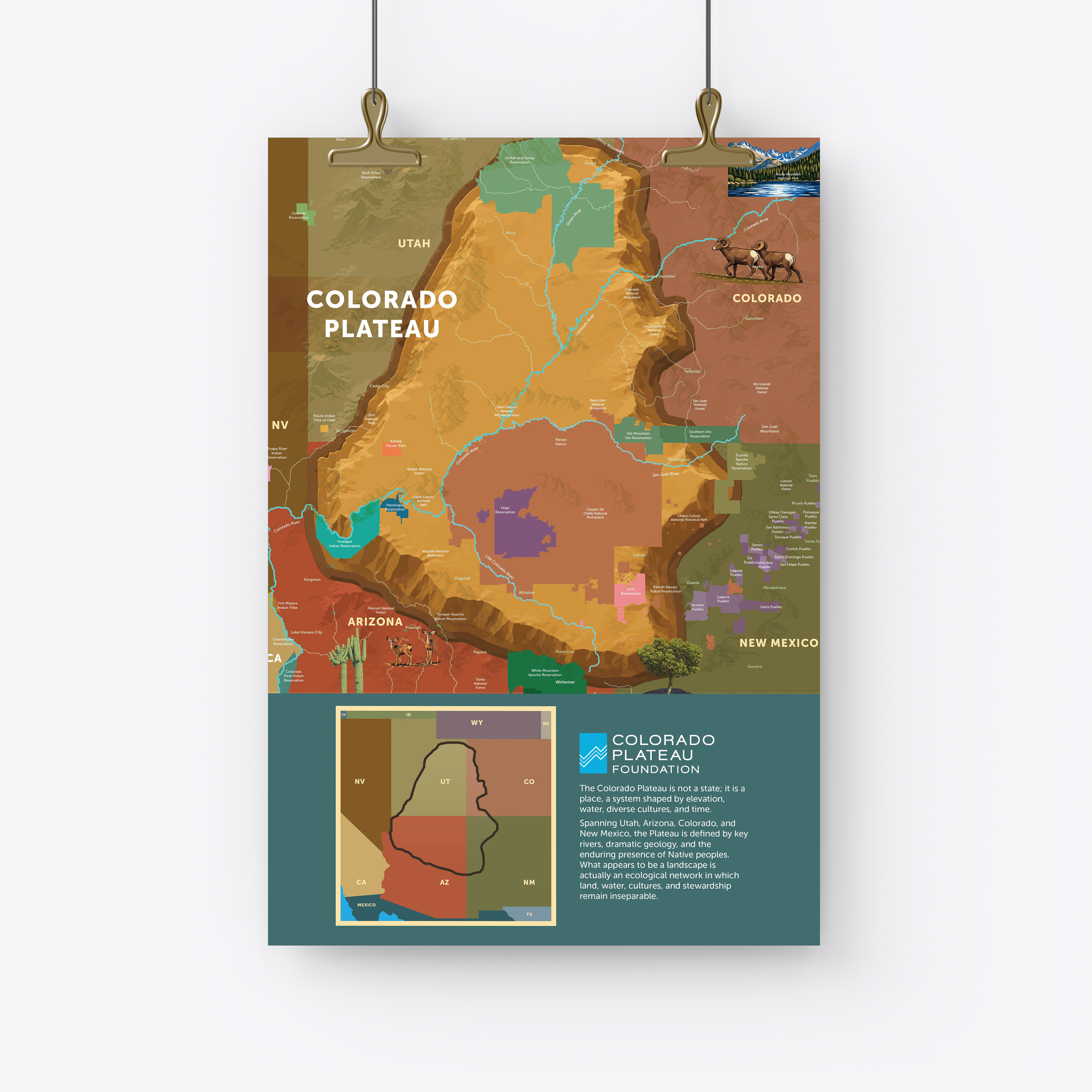
Narrative Map Poster & Regional Inset
To support educational outreach and public presentations, the final map was adapted into a large-format poster accompanied by a regional inset illustrating the Plateau's geographic position across the American Southwest. Together, these pieces provide both macro- and micro-scale context, helping audiences understand the Plateau as an interconnected ecological and cultural region spanning Utah, Arizona, Colorado, and New Mexico.
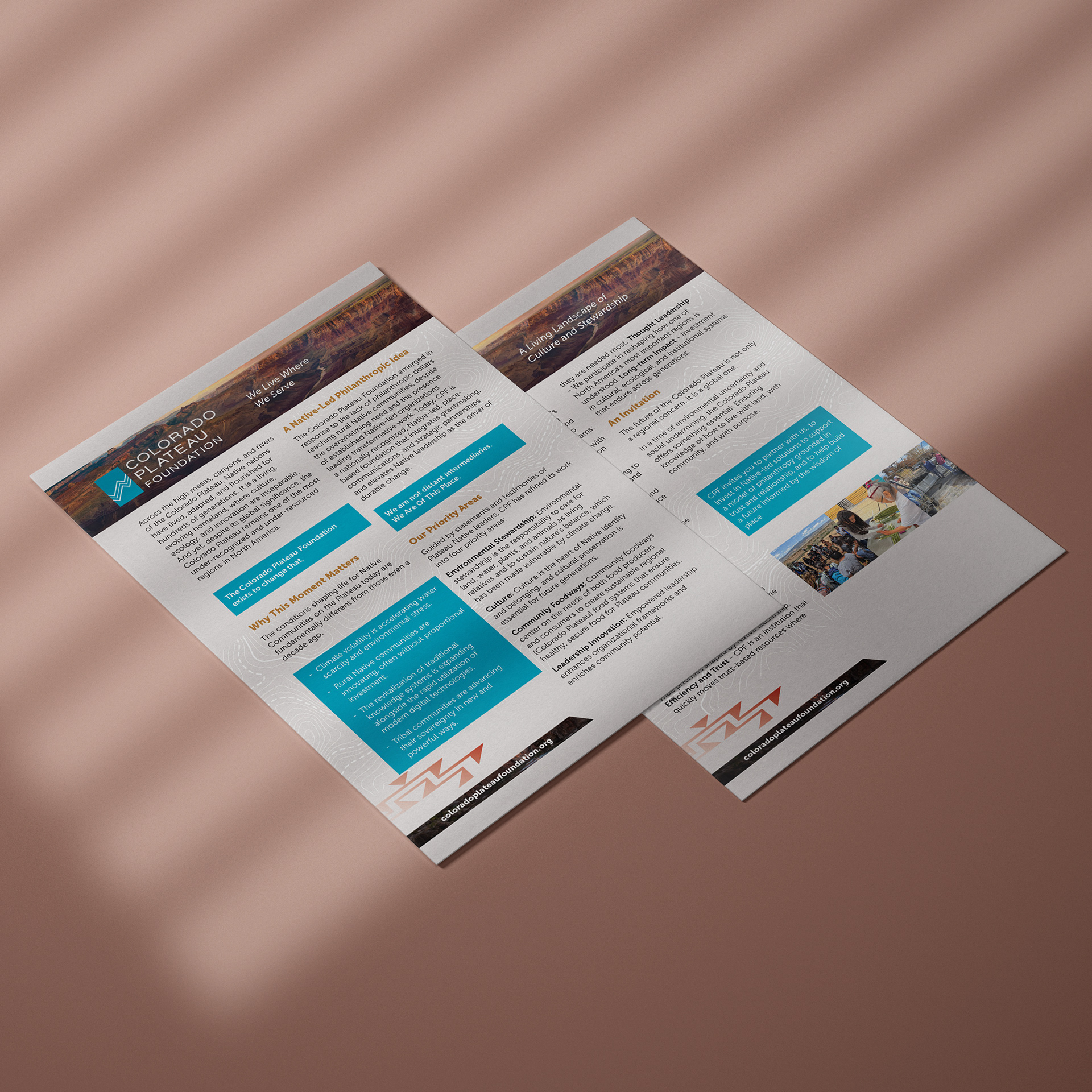
Case Statement
In addition to the illustrated map, I designed a multi-page case statement and supporting collateral that translated the Foundation's mission, priorities, and philanthropic vision into an accessible publication. Through editorial hierarchy, typography, photography, and information design, the publication establishes a clear visual identity while communicating complex environmental and Indigenous-centered initiatives to prospective partners and supporters.